The post from UUA President Peter Morales pretty much describes my trip from Guwahati to Shillong, Meghalaya. I traveled that road, met the people, and heard his sermon about crossing borders. Borders need crossing–international, spiritual, religious, cultural, neighborly–go for a win-win.
Category Archives: Uncategorized
Hindus, Catholics, and Unitarians
All these faith traditions and many more are readily available in Chennai, a port city on the east coast of India, on the Bay of Bengal.
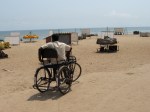
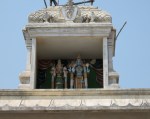
First stop, the Ashta Lakshmi Temple, overlooking the beach where we could see horses available for rides and people dotting the sand as vendors or beach-goers.
Lakshmi is the Hindu goddess of wealth, both material and spiritual. How fitting to begin here, to start a journey of such spiritual bounty. We had no idea at the time of the depths of this journey, only that it was called Sacred Places and we expected to visit many.
Lakshmi is shown as a beautiful woman with four hands who is seated or standing on a full-bloom lotus blossom and holding a lotus bud. Her four hands represent the four aims of human life: dharma (righteousness), kama (desires), artha (wealth), and moksha (liberation from the cycle of birth and death. She is a mother goddess who is addressed as Mata (mother) instead of simply devi (goddess).
A full description of the temple can be found here: http://saigan.com/heritage/temple/8lakshmi.html including professional photographs. I have uploaded some of my pix, but we were not allowed to photograph inside active temples. Ashtalakshmi is a very colorful temple, unlike some that we will see later on our journey.
As we ascended levels of the temple we encountered various deities. Lakshmi, of course was on the top, fourth level, facing east. Keep in mind that the pantheon of gods and goddesses in Hindu mythology are all manifestations of the Supreme God, Brahman. Devotion to one deity or another is acknowledgment of the desired aspect in one’s life.
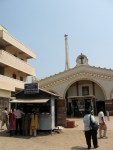
Next stop was St. Mary’s Catholic Church. Though Christianity is a minority religion in India, it boasts 2.4 per cent of a huge population. St. Mary’s is not fancy by any means but its focus on Mary is so refreshingly different from the symbols of crucifixion in most Catholic churches. Mother and Child overlook the altar and evoke the love and peace felt by countless mothers with their infants.
Lunch was enjoyed at a fancy Sheraton buffet. We were able to eat more quickly and with a wide array of options than ordering from a menu would offer. After all, some of us needed to ease our way into Indian cuisine. (Not I! Throughout the trip I feasted on marvelous dishes that varied by region and delighted my palate.)
After lunch we went shopping at Spencer Mall, where many of us first visited an ATM. The two shops Abhi recommended included fabrics, shawls, and scarves in one; and a large variety of good quality Indian merchandise. I was not ready on day 1 to purchase anything, but I thoroughly enjoyed looking at all the beautiful items.
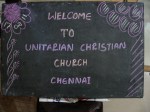
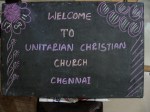
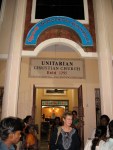
In the evening we visited Madras Unitarian Christian Church. It is located in a working class neighborhood, and that makes it easier to invite people of multiple social classes to feel comfortable. It was a Thursday evening, not easy for people to travel on a school/work night, but the place was packed.
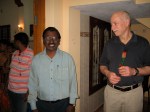
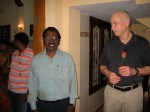
The minister is Harrison Kingsley, who was a gracious host. We were greeted by members who presented each of us with a flower. It was artificial, to be sure, but unlike fresh flowers I still have something to show for my visit!
We were ushered to the front rows of the church as honored guests. A program began with song. While Madras members sang in Tamil, we guests were directed to the English section in the back of the hymnal. Jointly and lustily we sang, “What a Friend We Have in Jesus.” They had wanted us to feel comfortable with a familiar hymn.
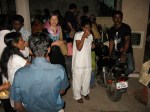
The evening’s entertainment included songs and dances by children and youth, repeated from a recent special event. We saw a slide show of the history of this church. As the program came to a close, the three ministers (Abhi Janamanchi, Justin Osterman, and I) and one director of religious education (Jennifer Halperin) were presented with colorful shawls. The closing hymn, also familiar and sung in either Tamil or English, was “Abide with Me.”
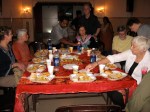
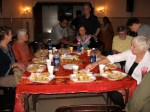
Social hour followed on the front patio. We were invited up to the Fellowship Hall for tea–plus a thoughtful selection of sandwiches, homemade potato chips, and a mildly sweet pastry. Most of the members continued to socialize downstairs! We enjoyed our repast and easily decided we had no need for a restaurant dinner.
Thus ended our first day in Chennai. We hit the ground running–no time for jet lag!–and fell into bed at the lovely Hotel Pride.
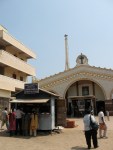
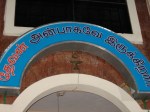
- Doorway to Unitarian Christian Church
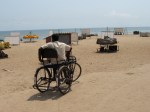
- Bay of Bengal
- scene 1 from the bus
- scene 2 from the bus
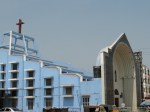
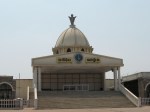
- St. Mary’s Catholic Church
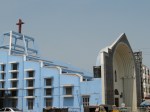
- Unitarian Christian Church
- Rev. Harrison Kingsley
- Established 1795
- Social Hour
- Doorway
- Ashta Lakshmi Temple
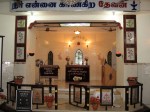
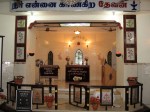
- Chancel
- Reception
On the move again
Our group was in the news back in Rajahmundry. There are many inaccuracies due to circumstances, assumptions, and language barriers, but how nice that we were noticed by the media! Also a story on local TV news that day.
Flights are heading back to the U.S. at various times today and tomorrow. Will do some backtracking and post other stories and photos from earlier in the trip as I recover from jet lag.
Meanwhile, one more shopping opportunity!
Thanks for reading along!
Kathleen
Unitarian Schools
From the Khasi Hills in Northeast India—Shillong, Meghalaya
This morning, 28 Feb 2011, we set out to visit 2 of dozens of Unitarian schools in northeast India. The Education Committee of the Unitarian Union now runs 37 Lower Primary Schools, 10 Upper Primary Schools and 4 Secondary Schools
The UU Church in Clearwater, FL, is a sponsor of the Margaret Barr Memorial School. The school has about 60 students from pre-K through 7th grade in the village of Lawsohtun. Founded in 1982, the school gets some funding from the State of Meghalaya but subsists mostly on donations. A few families can afford a materials fee of 20 Rs/month, but most of the students are from peasant families and do not pay. Most of them wore uniforms, and I’m sure they are handed down and altered.
Two rows of children politely lined up on both sides the gate to greet us with shy smiles and a corsage of ribbon and beads. Chairs were waiting for us in the shade of the porch where we enjoyed a program of welcome and songs from the children.
After the program we had a tour of the school. The computer room is the size of a closet. It has one working computer and one that needs repair. There is no internet, so all they can learn are applications. For languages, they study their native tongue Khasi, the more formal Hindi, and English. One class sang the alphabet song for us in English.
The head teacher and 7 other teachers receive appallingly low salaries—about 1800 rupees/month (less than $40). Government schools pay at least 3 times that amount, namely, 6-12,000/month. Even so, one of the teachers said he bought pencils and other supplies out of his salary. Before leaving the site, we took up a collection on the spot and gave each of them a cash bonus.
Margaret Barr, for whom the school is named, was a Methodist born and raised in Yorkshire, England. She became a Unitarian in 1921 as a student in Girton College, Cambridge, after a friend invited her to a service. The sermon that day was a scholarly and appreciative explanation of Hinduism. She loved the Unitarian approach to other faiths. Barr went on to become a minister herself.
While she was serving Rotherham Unitarian Church (1927-33) she learned about the indigenous Unitarians in the Khasi Hills of India and about their founder Hajom Kissor Singh. After a visit there she wanted to return. Several years later she got a job at a girls’ school in Calcutta that paid for her move to India.
Eventually she made her way to the Khasi Hills, where illiteracy, poverty, and ill health predominated. H.K. Singh had died and the congregations were floundering. She opened a school and trained teachers in Shillong. So that students didn’t have to leave home, she opened another one in Kharang, then a Dispensary, and finally made Kharang her permanent home. She would open schools in villages then turn them over to the Government. She died in 1973.
Clearly, Margaret Barr heeded the advice given to her by Gandhi: “Keep out of jail and find some constructive work to do.”
another blog
You can check out uuclearwater.org and find the link to Abhi’s blog–several people are posting to it as they have time, so it gives more perspectives. Today, going to a Unitarian school in Shillong to deliver many bags of school supplies that we have schlepped over many miles! Yesterday, services at 2 Unitarian churches. Peter Morales preached in one; Abhi Janamanchi preached in the other.
Shave and a Hair Cut
. . . or simply a heavenly head massage! We visited Abhi’s mother in Rajahmundry, and across the road was his barber who also gives head massages. I volunteered! He did the expected massage of temples, scalp, and neck, then started lightly pounding my head. Light became heavy as he really got a rhythm going. I thought about how strong skulls must be and figured my brain would benefit from a realignment! Mark Brandt took a video to share later.
Massage complete, the man picked up a spray bottle—I assumed to spray something on my hair—but it was my face! Cool sprays of water all over my face, then a soft towel dry. It was delightful. I was asking our tour guide how much to pay, thinking 100 rupees, but he said 20, then changed that to 30. So five minutes of bliss for less than a dollar. Namasté!
Krishna’s Farm
After an overnight train ride Tuesday in which I was lucky to be among 4 people in a 1st class cabin (most of the group was actually in 2nd class) we quickly de-boarded because the train just stops for a few minutes in Rajahmundry. Some of Abhi’s family members met the train to help with luggage and to get us to the hotel to freshen up. Porters carried 3-4 rolling suitcases on their heads and a smaller bag over each arm and we could barely keep up with them. Plus, they went up two flights of stairs and back down on the other side of the tracks to reach our rides.
The morning was relaxed; several of us lingered over breakfast to try to remember the chronology of the many temples and places we have visited. Then we took showers and got ready—for lunch! I tried the South India Thali, a traditional meal that claims to promote balance. At least the tray was balanced! Rice surrounded with small stainless steel cups of delicacies like vegetable curry and paneer. It was a great sampler—I tried some of everything though it was more than I could eat. Just after I announced that I must be balanced now, a cup of ice cream was delivered.
After lunch we visited Abhi’s cousin Krishna’s organic farm. We were greeted loudly by dalmatians from their enclosure. They would probably have loved to get at one of the chickens or turkeys! There were three calves, some cows, and some water buffalo. A three-week old calf was untied and jumped for joy—ran around friskily and also found its mother. The cowherd had to chase after the cow to get her back to the herd. The farm grows sugar cane and also has some coconut trees that produce water coconuts.
A worker with his machete and a rubber ring to hold him as he worked his way up a coconut tree, cut down a few for us. Then the tops were cut off until there was a small hole. A straw was inserted and each of us enjoyed refreshing coconut water. It is clear, and not strongly flavored like coconut, but it’s very good. We were served sweets made with cashews or dates. Delicious. So much good food on this trip!
The farm is right on the Godvari River. During last fall’s floods the river rose 50 feet! The farm was about 20 feet deep in water and sustained quite a bit of damage. The setting is absolutely beautiful and it was cool and breezy. Lovely hospitality.
Just a Moment, Please
(written Feb. 23, 2011)
Travel is a bit exhausting, especially when we have stayed in a different place four nights in a row. There have been wonderful hotels—Parisutham (means “very clean”) in Tanjore; Annamalai in Pondicherry, currently the Anand Regency in Rahahmundry. In fact, they are nice enough that we would love to stay longer! Tuesday night accommodations were on the overnight train from Chennai to Rajahmundry, after several day trips by bus.
Our bus driver and his assistant who drove us around in Chennai drove the bus to Madurai in time to meet us when we flew in. They have been excellent. The driver can make a 180-degree turn in Indian traffic–no small feat!
From now until we leave India, it looks like we’ll stay at least 2 nights in each place. Today we will meet at 9 to debrief, then go visit Abhi’s mother in her home briefly, then get to the airport for a 12:50pm flight to Hyderabad. Glad we’ll stay there longer!
Another frustration is Internet access. Each place is different; some have passwords, some have wireless, some have very slow or poor connections. I paid for 2 days in Chennai. Mainly, there’s just not enough time both to get connected and to scan email, FaceBook, and/or blog. This morning I have an extra hour because the bedside clock is incorrect—but the Internet is down……..
Then there’s the struggle with photos. I tried compressing one so it could be uploaded but that didn’t work. Next I’ll try to save them to our family website, but of course I have to be connected in order to do that.
Still . . . [Now there’s a good word—still. It has the “however” connotation and even more importantly, the “be here now” connotation. Be in the moment and in this place, this chair, this body, this spirit. I am in India for just 3 weeks and there will be time later to take care of all this busy-ness.Though I would love for everyone to know what’s happening currently, the stories and images are still good even after I get back. It’s a little like mailing postcards even though you will probably get home before they arrive.]
Still . . . I’m having a wonderful time. Travel is what it is and the benefits are enormous.
Still . . .
Breathe . . .
Smile . . .
Dancing Shiva
India is a land of beauty, contradiction, and spirit. At least that’s my impression after a mere 4? days in Tamil Nadu, a state in southern India. About 82% of the people are Hindu; another 12% are Muslim; 3% Christian, and 3% “everything else.” A small cohort of Unitarian Universalists have been on a spiritual pilgrimage to a variety of fantastic temples and churches.
The Rev. Abhi Janamanchi (UU minister in Clearwater, FL) is the leader in a group of fourteen. His wife Lalitha, tour guide Radha Krishnan (“RK”), and others have done an terrific job of planning, logistics, coordination, etc. They are often on the phone to make sure the next place is ready, the next tickets are confirmed, or a particular person will be present upon our arrival. For the first couple of days we were not allowed into the interior sanctuary. Frustrated by this, Abhi began explaining the nature of this pilgrimage—that we are not run-of-the-mill tourists but are there for our own religious reasons.
Sunday night at a Shiva Temple evening pujas (blessings) took place in an amazing multi-sensory fashion. They make Catholics look like pikers and they make my words totally inadequate to convey the experience.. Immediately upon entering the Temple our ears were assaulted with the clanging of bells, large and small, filling the granite space with deafening sound. Our group joined a throng of people watching as the priests performed the nightly blessings and rituals to prepare the dancing Shiva for the night. (Do deities sleep?)
Symbolic objects were displayed, fire blazed from multiple containers, chants and prayers were said, flowers and herbs were offered. There were several moments of silence then the bells would resume. As a non-Hindu I was both fascinated and mystified. Toward the end, a group of monks pressed into the crowd and we were gently pressed on all sides, adding additional tactile and olfactory sensations. That part ended and the bells were silenced.
After animated conversations between our leaders and temple “gatekeepers,” for lack of a proper term, permission was gained for us to enter the inner sanctum to receive special blessings. Men had to take off their shirts; one of the tour guides and two of our group did so. It is obvious who are the Hindus, with their sacred threads around their left shoulders. Women were allowed (fully clothed, of course.)
We got a closer look at the dancing Shiva and the priestly rituals using symbolic objects like a flag, a sword, and a mirror, and fire. I estimated at least 50 flames—tiers of 15-20 oil lamps hung on each side; larger fires closer to Shiva and the priests. Need I mention it was hot? Sweat was pouring down our bodies. (Taking my shirt off would have been lovely if rather ineffective!)
Several of our group left and I was on my way out when RK brought me back because the priests were about to do a special puja for our group. My colleague Justin Osterman (minister in Devon, PA) also came back. He and I stood by a railing on one side of the aisle.
Trays of offerings like coconut and flowers were brought by, along with trays of fire. We had learned enough to hold our hands over the flame then draw our cupped hands toward ourselves 3 times. Prayers were offered for the group. A priest came to us individually, asked our name, and recited a blessing for each of us. Then we made our way back to the main temple. Again Justin and I were called around to the front where the priest marked our foreheads with red powder and gave us a packet of the powder and a sprig of herb for longevity. Justin was especially urged to stay or to come back and look for this priest. We felt very blessed; we made a special donation (that’s how they survive) and went back to the group.
Our attention was gained once more as the priest came to us with long garlands taken from the neck of dancing Shiva. He ceremoniously placed them over our heads with more blessings. It was like an ordination. What an extraordinary moment! Before we left the Temple altogether, Abhi took a picture of the two of us in front of a statue of Durga. I’ll post it when he sends it to us.
[Note: the whole evening can be interpreted as an elaborate shill—we look intrigued, we receive special attention, we give donation, we get even greater blessings. What an effective stewardship program, with plenty of follow-through!]
But the blessings were real; the feelings were overwhelming; I am still taking it in some ten hours later, after a 2-hour bumpy bus ride and some sleep and a new day dawning. Outside the temple, Abhi negotiated for a small dancing Shiva for me (and others in the group) for just 200 rupees (about $4). He is no ordinary souvenir. He is a reminder of an amazing sensory immersion.
arrived safely
Everyone and our luggage arrived safely, most of us between midnight and 4am. Touring starts this morning at 10. We are 12.5 hours ahead of Central Time so it’s pretty easy to keep track.
Yep, the driving is adventurous here! Stop lights and white lane dividers seem to be “suggestions” for drivers. And that was in the wee hours.
Pride Hotel is very nice. The lights don’t work unless you put your room key in a slot on the wall. Very clever! They don’t work at all this morning–maybe we don’t get juice during certain hours. Don’t know…