Category Archives: travel

Alaskan Rainforest!

Standard

Sept. 23, 2011

For this outing in Ketchikan, AK, we dressed for cold, wet weather and boarded a Grayline bus. Five passengers were on their way to drive jeeps and do some canoeing. Jon and I were among 16 to go canoeing and take a short nature walk into the rainforest.

How beautiful!

Lots of waterfalls on the road to the Lake Ward, about 5 miles north of Ketchikan on North Tongass Highway. We were issued life jackets and ponchos then climbed into two large canoes. With that many paddles no one had to work too hard! Still, we used muscles I remember from teaching canoeing as a camp counselor many years ago.

We passed a steep waterfall (though not too closely!). Several times we stopped in the quiet and shouted to hear echoes sounding for as long as 20 seconds. Halfway around an Blueberry Island we stopped for a snack of dried salmon, bread and jam, goldfish crackers, clam chowder, and hot chocolate or coffee. The tour hosts joked that since we had been on a cruise we couldn’t go more than an hour without eating. The chowder and hot chocolate tasted especially good to me.

After the snack, Matt and Christina led two separate groups on a short mile-long walk into the rainforest. Among the hemlocks and other beauties we stopped by a creek with shale in it. Some of the shale has stripes of gold that gold miners used to mistake for the real thing. Alas, it is not even fool’s gold.

There are snags in the forest–dead trees that are still standing; and nursery trees–fallen logs; all of which provide shelter and nourishment for other forest life. A particular tree fungus called “bear bread” is also used by totem pole carvers to make a model for the actual pole. Rituals and prayers precede the use of any log. In the Tongass National Forest, nature takes its own course. Only logs that fall across the designated trail are cut away.

One tree was hollow enough for Matt, a good-sized young man, to get inside. A little mud won’t deter a guy who will spend his second winter in these woods. We made our way back to the canoes (more snacks available if desired!) then on around Blueberry Island. A light rain was falling and I was fascinated by drops of water that formed bubbles on the surface of the lake and remained there for several seconds before they popped. I haven’t ever noticed so many raindrops do that before: was it the relatively smooth lake surface, the air and water temperatures, the lightness of the rain? By the time Matt finished talking about points of interest around the lake I had forgotten to ask him.

Back to the dock to turn in our paddles and such then head back to town. Shops there were closing for the season so shopkeepers were eager to offer discounts and bargains galore. First we spent about an hour in Discovery Center until it closed. I could easily have stayed another hour there to view its displays of marine and forest life as well as the history of industry like logging, fishing, and mining.

When the Discovery Center pushed us out the door, we did do some shopping. There are some beautiful handcrafted items actually made in Alaska. One shop was way out of my price range but they do carry some wonderful items. In another shop I couldn’t pass up a small wooden bear holding a salmon, a signature wooden whale tail,  or a metal sculpture featuring whale and sea turtle.

This slideshow requires JavaScript.

Glacier Bay

Standard

Sept. 22, 2011

The cruise ship Norwegian Pearl entered Glacier Bay around 6:30 AM, before most of the passengers were out and about. What a day of beauty!

Two hundred fifty years ago there was no bay. Ice filled the entire region. Glaciers have since advanced and retreated multiple times but the net result has been the gouging out of stone into sediment, shoved into the sea or broken off at the edge in a process known as calving. The ice appears blue because all other colors are absorbed.

Last night decks were cleared due to 60 knot winds. No one was allowed on the open decks. Tables and chairs were pushed to the sides; in the chapel, furnishing were laid on their sides. The captain announced that we might not even be able to enter the bay through a narrow strait. Until 8 or 9 in the morning rain poured. (Remember rain? Austin could surely have used 30 minutes’ worth of this downpour!) We were afraid our view of the glaciers would be heavily obscured by rain and fog.

The skies cleared just enough for a beautiful view of mountains of various elevations, shoreline, rivers thousands of feet in length, glaciers two miles wide, and moraines, We spent an hour in sight of Margerie Glacier, circling around so that both port and starboard had plenty of viewing time. From time to time the sun would come out just enough to illuminate fresh snowfall on mountain peaks.

Three National Park Rangers had boarded the ship early in the morning. Throughout the day they made presentations, answered questions, and provided maps and info about Glacier Bay National Park. As we moved south we marveled at other glaciers such as  Johns Hopkins, Lamplugh, and Reid Glaciers .

Between glaciers and ice fields, the trees were gloriously colorful for the Fall Equinox. Plants of gold and red contrasted with evergreen and deciduous trees, dark rock, white snow, and blue ice. Within two or three hours we had come far enough south to see more signs of life: hundreds of sea lions, several sea otters, and a humpback whale coming up for air with a big blow to clear its nose.

The sea lions appeared to be resting on several small islands, but occasionally they would slip into the water to feed. Sea otters lay on their backs out in the water–we could see both head and tail above sea level. Birds flew or floated on the water. A bald eagle sat in a tree at my eye level.

People lined the edges of the ship, from the 7th deck all the way up to the 14th, with our cameras and binoculars and the warmest clothing we had managed to bring with us. We could retreat for warmth to the Spinnaker Lounge where windows surround the entire bow of the 13th deck or to a restaurant for a hot drink. How many gallons of coffee, tea, and hot chocolate can approximately 2300 passengers and 1100 crew members consume?

pix and videos below. A longer video captures a Park Ranger describing the landscape; a brief 5-second one captures a small icefall calving into the ocean just left of center.

This slideshow requires JavaScript.

Landscape

Ice falls into Glacier Bay

Almost Missed the Bus!

Standard

Sept. 21, 2011

Skagway, AK. An early docking where we would meet a guide to take us up to White Summit Pass. Big problem–in our haste to get off the ship and to the bus we forgot our passports! Since we would be going into Canada we had to have them.

Fortunately driver Shawn said he could pick up a couple of passengers from another ship and swing back to meet us. If we made it back in time he would pick us up. We ran back to the ship, got through security, rushed to our stateroom and retrieved those small but essential items. It was a good aerobic workout. We actually beat the Shawn by 5-10 minutes and almost gave up on him. All the passengers cheered when we got on this time. Hooray! (Shawn earned a big tip for coming back for us!)

Instead of taking the narrow gauge train up the mountain, we opted for an over-sized van equipped for about 25 passengers. Instead of the trains or large buses, our driver could stop at many overlooks on the way. At the Canadian border we basically had to hold up our passports while an agent compared the terrible photos with our gorgeous faces. (When we crossed back into the States, the U.S. guy didn’t even look at them, but questioned the driver. After all, he could say it was the same group he had taken with him from Skagway . . .)

One point of interest was a 400-foot steel cantilever bridge built of three hinged arches. Though major earthquakes are rare here, there are hundreds of tiny ones daily. This bridge, constructed in 1901, is designed to allow for that. In a really strong earthquake one end will separate yet leave the bridge attached safely at one end. (No, I can’t quite figure that out, either.) The Gold Rush enjoyed no such amenities, just a hard climb with tons of supplies carried over White Pass.

Scenery was spectacular in every direction from meadows to mountains. So many waterfalls, a range of plant colors, and black or gray rocks. I took a picture of a waterfall with just a little bit of blue sky at the top of a V. We got our passports stamped in Fraser, AB, just for fun. Shawn took pictures of us with our own cameras in front of the Welcome to Alaska sign on the way down.

Back in Skagway, Jon actually found a good sale on shirts and bought a couple of them. Guess what color they are? I bought some souvenir socks!

This slideshow requires JavaScript.

Whale Watching!

Standard

Sept. 20, 2011

Juneau, AK: Whale Watching!

We docked in Juneau and disembarked to find an Adventures Galore  guide. A small shelter conveniently protected our small group from the light rain. When everyone had arrived, we traveled by shuttle to a dock where a small boat awaited our arrival. It had an enclosed cabin plus space to stand in the bow and stern.

Twelve passengers, a driver, and a guide set off in a hurry across Auke Bay. Two outboard motors pushed us across the cold, choppy waters. In the distance we saw some spouts (“blows”) from whales, but we went further and saw, in quick succession, 7 whales! At least one of them was a calf.

These humpbacks normally live independently (or with calf) unless the feeding is very good. Apparently the herring were plentiful and the whales were on a feeding frenzy. Each herring has about the same calorie count as a Big Mac, and about that size. The whales are fattening themselves up for migration  all the way to Hawaii. Some of them have already begun the journey; the ones we saw will be gone by the end of the month.

The whales do not eat after they leave Alaska. They lose 10 of their average 40 tons (roughly one ton per foot of length). Perhaps one third of the females will breed in Hawaii. Gestation is 18 months, so the calves will be about 6 months old when they make the first trip, still drinking mom’s milk. Whale and calf will stick together another year.

We saw some of the whales roll, showing off their lateral fins. Sometimes we would see the humped back then the famous notched tail arching high over the water as they make another dive. They surface 3-6 times then submerge for about 7 minutes, though they can stay under water for up to 40 minutes according to our guide David. We were too busy watching with scanning the surface with eyes or binoculars to bother with cameras. The whales were pretty fast!

After that visual feast, we motored back pretty darn fast over very choppy water. I stood in the stern, tucked into a corner, enjoying the speed, the wind and cold, and occasional splashes of water. Even the tour guides were excited to see so many humpbacks in one place. We didn’t see any orcas, though. David had wanted to bid farewell to them as well.

After a bit of poking around Juneau shops we headed back to the ship for a warm shower and dinner. On a cruise, there’s never a need to skip a meal no matter what time of day or night! The Pearl set sail again at 10pm.

This slideshow requires JavaScript.

Patti Tana at Sea

Standard

Sept. 19, 2011

My feast of poetry on this cruise included Patti Tana’s This Is Why You Flew Ten Thousand Miles. The ‘why’ refers to Lilliana, a girl adopted from China whose parents flew that long distance to bring her to a new home. The parents had prepared a home surrounded by love and decorated the nursery

Parents and prospective parents will go long distances to give birth, adopt, or foster a child. Then for a lifetime they will strive to protect and empower; to love and let go. Ten thousand miles or about ten thousand days may be what it takes to launch a child. She or he is still very much our child, no matter how long we live.

For a time we find ourselves in the sandwich generation when we have both children and elders for whom to care. Parenting is one way to learn the skills needed as parents and grandparents become increasingly frail and vulnerable. Our children may in turn have a chance to assist us in our later years.

Patti writes about living, loving, and “daughtering.” She writes of the delights of parenting and the despair of loss. Many of her poems are very sensual in nature.

I “met” Patti on the phone shortly after I repeated an error in a newsletter. The article had attributed her poem about a garden/gardening to Anonymous. The closing line, “That Patti, she was one hot tomato” did not refer to her demise but of her own wish for her personal legacy. At least that’s how I remember it several years later.

At any rate, Patti tracked me down and gave me a call to correct my mistake. “I’m not dead,” she told me. I enjoyed a delightful conversation with this New York Jewish poet who teaches as well as composes poems. I bought a couple of books from her and she sent me an extra. This Is Why You Flew Ten Thousand Miles, her latest publication at the time, became part of my collection. I loved it so well I bought a second copy for a friend who had adopted a Chinese daughter.

By the way, I also read a book of poems by Hafiz on this trip, but I think he will not call no matter what I say about his poetry!

Here’s a short poem by Hafiz:

The Happy Virus

I caught the happy virus last night

When I was out singing beneath the stars.

It is remarkably contagious –

So kiss me.

“The Happy Virus,” The Subject Tonight Is Love:
60 Wild and Sweet Poems of Hafiz, versions by Daniel Ladinsky
Pumpkin House Press, 1996, p. 40.

This slideshow requires JavaScript.

Precious Times

Standard

Precious Times Sept. 17-18, 2011

Anticipating ten days away in a cooler climate, two extra blessings preceded and accompanied me on the trip. A 92-year old member of the church quietly passed away about four hours after I visited her. This time she probably did not hear my prayer, song, and farewell, but she is fully at peace now and that is a blessing.

On the day of our departure, a long-awaited and healthy baby Sophia Elizabeth was born at home. Her parents, big sister, and countless others count her birth as a special blessing.

These two life transitions filled my heart with a wonderful sense of peace while I packed last minute items for our journey: an Alaskan cruise! Jon planned it all and gave me this gift of a lifetime–something I have imagined only in my dreams.

We flew Alaskan Airlines non-stop from Austin to Seattle. There is just one flight per day, so we spent one night in Seattle before the cruise. We took light rail–SeaTac to the closest station to the port and walked through Pike’s Market to watch fish being tossed around for customers’ entertainment.

A guy named Russell walked with us from the train. He is a flight attendant for Southwest Airlines, based in Chicago. Every time he comes to Seattle for the day he makes this trek to the Market. He told us where to find an elevator down to sea level. Walking along the boardwalk, we cheered on a Susan G. Komen fundraising walk. Lots of pink ribbons, outfits, and tutus. Several decorated vehicles carried other happy participants in the fight against breast cancer.

There was no need to ask directions any more–the Norwegian Pearl loomed over the dock with its 14 decks. Embarkation was smooth and efficient. Fourteen staff members checked us in and gave us key cards. That was all we needed to make additional purchases on the ship. Meals were included in the cruise fare unless we wanted to go to a specialty restaurant, drink sodas or alcohol, gamble, or buy clothing, jewelry, art, or souvenirs on board.

Our only additional expenses were a room service fee (added automatically), one glass of wine, and one embarkation photo. Souvenir shopping was all on shore.

Tomorrow we will be at sea all day, on the way to Juneau. Stay tuned for more!

North to Alaska!

Standard

Tomorrow my husband and I will be flying to Seattle in preparation for a cruise into the Inland Passage! The Norwegian Pearl sails (metaphorically speaking) on Sunday afternoon for a week of wonder. I have wanted to do this for years. Thanks, Jon!

Ports of call include Juneau, Skagway, and Kethchikan, a few hours in Victoria, and finally to Vancouver. It is the last cruise of the season. Expected highlight is the cruise through Glacier Bay–everyone raves about it.

Day trips so many thousands of tourists have taken:
Juneau: a smaller boat to go out looking for whales;
Skagway: up to White Pass Summit;
Ketchikan: rainforest canoe and nature trail.

We’ll spend one night in Vancouver then board Amtrak to get back to Seattle. Jon’s daughter, some cousins, and an uncle live there, but alas, we won’t have much time to visit. Back to Austin late the 27th, ready to pick out the best photos to share!

What a grand adventure awaits! Now, let’s see if I can pack an extra sweater….

Journey of 1000 Miles

Standard

Sermon delivered June 5, 2011

Today marks the beginning of our summer of proverbs! Children, youth, and adults will be engaged in the same topics each week.

“A journey of a thousand miles begins with a single step” certainly gets a lot of traction! saying is attributed to Lao Tzu, who lived over 2500 years ago. Confucius also got credited, though he was born 20 years after Lao Tzu died. And we keep on saying it because it applies to just about every person and every new venture that is ever undertaken.

Consider this morning’s parable. Tony went to summer camp as an art student. His bunkmate Andy attended as a drama student. Each boy helped the other one overcome obstacles so that Tony could participate in a play in spite of his fear of forgetting lines, and Andy learned how to use a potter’s wheel in spite of having only one arm. It just happened that they met each other and coaxed something new from a new friend. You can probably remember a time when someone said just the right thing to point you in an unexpected direction.

The title “Journey of a Thousand Miles” shows up all over the internet. I found it on a personal finance blog that said if you want to get out of debt, start with a list of everything you spend for a month. There’s also a wedding blog, Journey of a Thousand Miles, that tracks a bride and groom’s journey from their engagement to a destination wedding and honeymoon. An autobiography, Journey of a Thousand Miles: My Story, shares the life of a boy in China who eventually travels to Europe then America then on the world stage through piano performance.

Life itself is a journey. All of us could tell a story about a truly significant turning point or moment when something new began. A new baby, an empty nest, a graduation, a new job—are common experiences that occur only after a period of preparation. David Brooks had a good message for recent college graduates when he said, “It’s not about you.” Brooks says, “Most successful young people don’t look inside and then plan a life. They look outside and find a problem, which summons their life. . . . The purpose in life is not to find yourself. It’s to lose yourself”[i] in something that calls to you.

That resonates with a phone conversation I had with Ruth Chatfield, our eldest Live Oak member. For her, the reason to do something comes from an urge to be of use and to make a contribution. She has just come home from the hospital and doesn’t know what contribution she can make any more. She wanted me to tell you that there are some Very Good People at Live Oak and she wouldn’t know what to do without you. She couldn’t come to church today because a home health nurse will be visiting her every morning for 30 days to help her with medication and other needs. During Ruth’s 92 years she has undertaken countless journeys, especially in the world of art and music. She was a dancer, then a violinist, then an artist, then a potter—redirected each time because of a specific medical challenge. If anyone knows about journeys, Ruth certainly does!

Sometimes a journey gets kick started when you feel lower than a snake’s belly or lost in the slough of despond. My friend Jim, who spent 3 ½ years in a federal prison, said the journey to hell also begins with a single step. He is out of prison now and after a few years of struggle he is finally ready to move on. His youngest son graduated from high school this year. The sense of completion seems to have provided the incentive Jim needs to refocus on his own life.

An organization that was born out of the pain of a daughter’s death grew to become “For the Love of Christi.” Hundreds of families like Live Oak’s MacIntoshes and Von Alts have been helped through enormous grief. Now they, in turn, provide support to other families who suffer the death of a child. No one understands better than someone who has shared that experience. Yesterday an addition to the Christi House was dedicated. Christi’s parents Don and Susan Cox were there with gratitude for generous donations of time, money, and in-kind donations ranging from the concrete slab to the living room couches. A moving prayer was offered by the Rev. Dale Schultz, senior pastor of St. Phillips United Methodist Church in Round Rock.

Whether it’s a gradual decision or a devastating event, there finally comes a moment to act. Mary Oliver in her poem “The Journey. ”    [Here’s an excerpt. Entire poem easily found online.]

One day you finally knew

what you had to do and began,

. . .

determined to dothe only thing you could do—

determined to save

the only life you could save.

What makes us decide to embark on a journey of any sort? A tragedy, a chance encounter, a suggestion, thoughtful consideration?

Fifty years ago the first Freedom Riders got on buses in Washington D.C. and headed south with a determination to raise the issue of unfair racial laws while remaining non-violent no matter what happened. They were indeed met with violence, especially in Alabama and Mississippi. Brutal beatings, fire bombing one of the buses, and prison time for hundreds. After the first group of a dozen or so were forced to return home, more waves of young adults, black and white, boarded other buses. Non-violent protest stood in stark contrast to public brutality until finally the Kennedy administration was forced to uphold federal laws of equal rights. We continue to challenge injustice wherever it occurs.

Thirty years ago odd cancers and pneumonia began showing up among young gay men in New York and California. These were the first harbingers of a catastrophic pandemic that has infected over 60 million people and killed at least 30 million. In 1981 no one knew whether it was a new disease, what caused it, how it spread, how to treat it, or even a name for it. AIDS research has been a long journey full of trial and error to achieve today’s better treatment and education about prevention, but there is no vaccine yet and the trials and errors will continue for a long time to come.

What makes us decide to embark on a journey of any sort? I like to believe that it’s a combination of fact, context, and intuition. But apparently there’s a lot more to decision-making before it even reaches a conscious level.

Some of you probably heard Dr. David Eagleman on Fresh Air this week[ii] or saw him on TV or read about him in the New Yorker magazine. He is a neuroscientist at Houston’s Baylor College of Medicine and a writer and speaker. His latest book Incognito explores the neurons and brain activity that compete for attention and influence how we act, what attracts us, and what we think. Eagleman says that all of this happens after an internal lightning storm of electrical impulses that operate quite without our conscious awareness.

Brain cells make up the 3-pounds of gray matter we each carry around in our skulls. The cells are made of hundreds of billions of neurons and glia that are as complicated as a city. Electrical pulses to other cells measure up to hundreds of times per second. That means, Eagleman says, that there are as many connections in a single cubic centimeter of brain tissue as there are stars in the Milky Way galaxy.

It boggles my mind—in a happy way! Conscious thoughts in making a decision cannot even begin to capture that level of connectivity. Behavior, thoughts, and actions might seem to appear out of the blue, but we don’t even have a way to describe what’s happening. You could damage your little finger and still be you, but if you damage that much brain, it might affect your ability to speak, to understand music, to avoid a hot stove, or to recognize yourself in a mirror. When the brain changes, so do we. Most of its function is below conscious level but ultimately it controls our journey of thousands of miles.

Having been introduced to Dr. Eagleman, I kept reading interviews with him and watching his videos. His previous book Sum is a journey of possibilities. After all, he calls himself a Possibilian. For this book he selected 40 possible “reasons for our existence and the meaning of life and death.” In various stories, maybe “God is a married couple,” or “God is the size of a bacterium,” or “life runs backwards after the expansion of the universe reverses and you get to see all the details you mis-remembered.” [iii] When he made up the word possibilian in a lecture, hundreds of people had emailed him by the time he got back to his office, so he did the modern first thing: launched the website possibilian.com. Check it out!

As a Possibilian, Eagleman rivals the late great Carl Sagan in his ability to fascinate audiences about science and its creative process. So much scientific knowledge has been gained over the past 400 years! “We reached the moon and eradicated smallpox and built the Net and tripled life spans.” It’s like we are building a pier out into the ocean or out into space. One by one we add planks of knowledge to the end of the pier for new generations to follow. But eventually, standing at the end of the pier, all you can see in the distance is mystery. Eagleman describes mystery as “The equivalence of mass and energy, dark matter, multiple spatial dimensions, how to build consciousness from pieces and parts, what life and death are about, and so on. I have no doubt that we will continue to build the pier out, several new slats in each generation, but we have no guarantee how far we’ll get. [iv]

From the depths of one of those nematodes found deep in a South African cave to the outer reaches of space, the frontier beckons. Enjoy this time lapse view from four Very Large Telescopes in Chile. Let your mind soar on a journey through space and time.

http://www.popsci.com/technology/article/2011-05/time-lapse-video-very-large-telescope-work-coolest-thing-youll-see-today

We are a part of this!  We may not know where we’re going, but we are on the journey!

Amen


[i] A version of this op-ed appeared in print on May 31, 2011, on page A23 of the New York edition with the headline: It’s Not About You.

[iv] Ibid.

Running on Empty

Standard

Reflections on Hunger, here and in India, 29 May 2011

An Organic Farm and a Basti (slum)

A couple of weeks ago, Audrey and Linda facilitated a Prayer Bead workshop. Participants talked about prayer and what it means or doesn’t mean, and we had a chance to make a set of prayer beads like these and a felt bag to keep them in. How many of us would even have been interested ten or fifteen years ago? Yet there we were—more than 20 of us. It was a fun craft project. It was a social event. There was a delicious lunch, thanks to Audrey. But for many of us it was a moment in time to focus on a spiritual hunger. We have all we need in terms of food and material wealth. We have plenty of things to do and multiple ways to give of ourselves. Sometimes that’s the problem. We tend to give of ourselves until our Selves are depleted. We find ourselves running on empty.

Many of us are hungry for WHOLENESS.

 Perhaps all of us are hungry at one level or another.  “I’m spiritual, but not religious,” is a frequent mantra. Spiritual hunger might refer to an ill-defined empty feeling like something is missing, like life has no meaning. We can fill ourselves with work or mindless television or reading or shopping or eatin0g or love. We can spend more time in meditation or in nature or in relationship. There are plenty of negative and positive ways to fill a spiritual hunger.

My trips to Japan in 2003 and to India this year exposed me to different cultural expectations of spirituality, more than other countries I’ve visited. This morning I’ll take you on another journey to India. You won’t even need to spend 25 hours of travel to get from Austin to Chennai, a port city on the southeast coast of India, on the Bay of Bengal. The Rev. Abhi Janamanchi, minister of the Unitarian Universalist Church in Clearwater, FL, led a group to his home country: to “Sacred Places” in south India, and to Unitarian schools and churches in northeast India, and to Delhi and Agra in north India over a 3-week period.

I knew that India would be a land of contrast—such as wealth and poverty, beauty and squalor, temples and slums. I knew I would be entering another culture and that it would be wise for me to let go of expectations and let go of quick judgments. Abhi’s objective was “to provide [us] with an in-depth experience of life in India, especially in smaller towns.” Our spirits were filled by what we experienced. We became pilgrims in an immersion experience.

Our bodies were filled with delicious Indian food—

  • idly with chutney or sambar,
  • dal with vegetables,
  • shahi paneer, and
  • plenty of steamed rice or parathi or naan.

Hindus eat meat but not beef; Muslims and Christians eat beef.

One guy joked that with his luck he would come back in his next lifetime as a cow in a Muslim neighborhood!

 Two particular destinations in India were related to food.

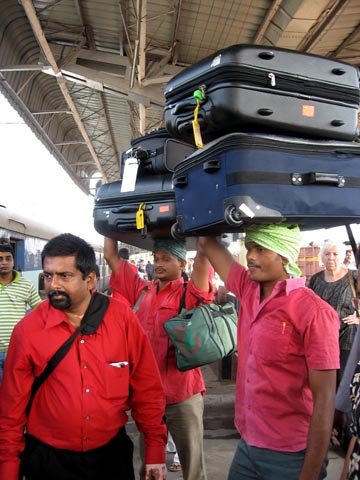
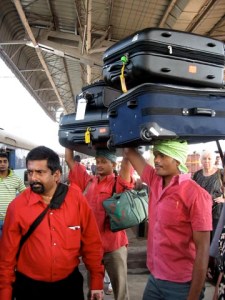
One of them was in Abhi’s hometown of Rajahmundry (a “small town” of 800,000). We took an overnight train (an adventure in itself). The train stopped for about 5 minutes so we were all lined up in the aisles ready to toss luggage out to his family and friends. We were AMAZED to see how much luggage they could carry!

 Luggage
 

We visited Abhi’s cousin Krishna’s organic farm right on the Godavari River in the city of Rajahmundry. The Godavari is one of the longest rivers in India, about 900 miles. It flows all the way from Mumbai in western India through this southern area and on to the Bay of Bengal, so it collects water across many miles. The widest portion goes through Rajahmundry—a little over 3 miles to the other side.
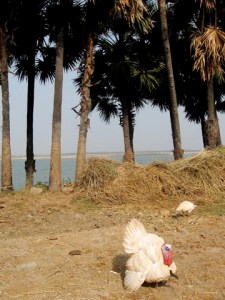
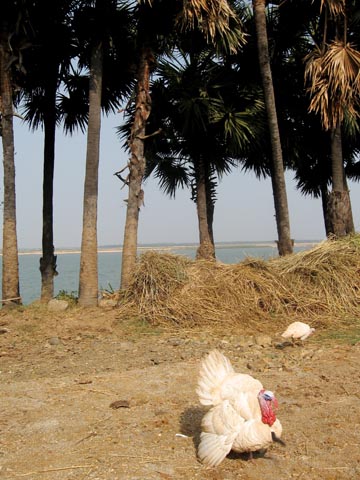
The farm sits on a bank 30 feet above the river. We could see islands where fishermen lived and worked, but in the rainy season those islands will be submerged. In fact, last August the river rose 50 feet and the farm was flooded by 20 feet of water. Krishna and crew had had to move the cattle, water buffalo, turkeys, chickens, guinea fowl, dogs, and people to higher ground. Crops sustained quite a bit of damage—the sugar cane, mangos, bananas, cashews, coconuts, and rice.

Krishna showed us how sugar cane is laid on the ground lengthwise and grows new sprouts from those canes. Sugar cane has an 11-month growing season. Rice is planted between the rows and is harvested twice a year, after a 4-month growing season.

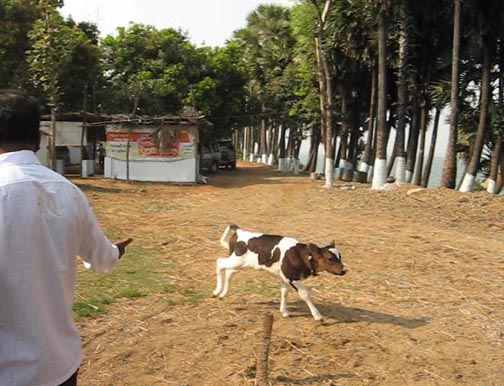
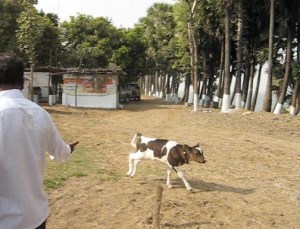
Here’s a picture of a 3-week old calf that was untethered and frolicked around until he caught his mother’s attention. She left the herd and came running over to greet her youngster until the cowherd managed to bring her back.
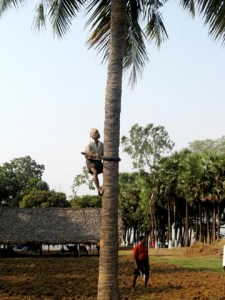
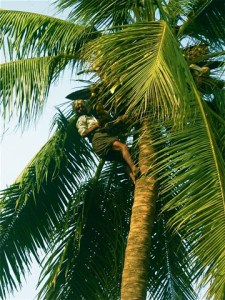
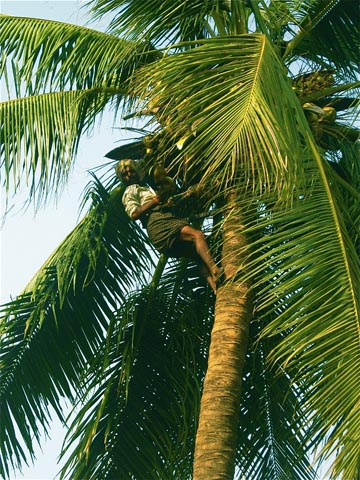
One of the workers climbed a palm tree in his bare feet with only a rubber belt for safety and a machete to cut down bunches of coconuts for us to enjoy.

 Ready to Climb
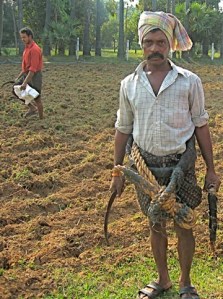


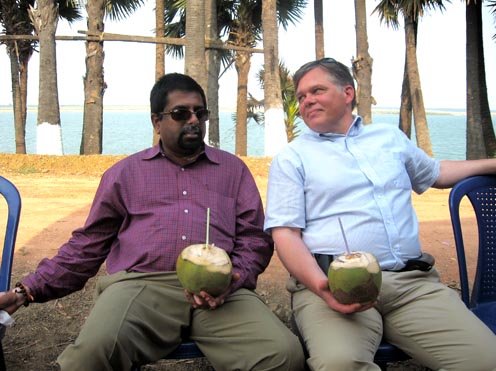
This variety of coconut is full of water, not milk! The farmworker expertly chopped off each top, inserted a long straws inserted, and we enjoyed a delightfully refreshing drink. Coconut water is clear, without a strong flavor, but it’s very good.  We also ate some of the coconut meat and sweets made with cashews, dates, and mangos. A farm is an excellent place to see a direct link from the earth to our bodies.


 The Revs. Abhi Janamanchi and Justin Osterman

We recognized some common farming issues: farmers markets, organic produce and meats, and healthy recipes. There are challenges in farming and distributing nutritious foods, especially locally grown organic foods, and especially when weather or flooding is not under the farmers’ control. There is also a very spiritual connection between food and personal values.

On Friday, the Rev. Eliza Galaher, minister of Wildflower Church in south Austin, encouraged her congregation to fast all day, when they had a worship service at 6pm then broke the fast with simple vegan soup and bread. There is a strong link between spirituality and food—choosing where to eat and with whom, selecting ingredients or menu items, preparing and savoring food. Body, mind, and spirit can best be nourished when we tune in to what we truly crave.

Taking into consideration great advances in agriculture, technically there is enough food in the world to feed everyone. The population has grown by 70%, but world agriculture now produces 17% more calories per person than it did 30 years ago. Poverty is the main culprit—no land to grow food and not enough income to purchase enough food. People in developing countries live on $1.25 per person per day or less—the cost of one song on iTunes. The reasons for poverty are vast and complex.

Statistics on world hunger are estimates based on income per capita vs. the cost of food in various parts of the world. It’s not an exact science. About 14% of world population is hungry, approximately 925 million people.

In medical terms, hunger means malnutrition. The first and most important is protein-energy malnutrition. Protein-energy is a combination of adequate protein plus enough calories from all the basic food groups. The second type is micronutrient deficiency. Micronutrients are not even considered with respect to world hunger. A new and growing concern is the over-abundance of poor food choices that can lead to obesity as well as malnutrition.

But why should anyone be hungry or malnourished? Why are people poor? In brief, economic policy, corruption, lack of education, hunger itself, which leads to lack of energy, depression and disease, climate change, and war. Nearly all of the undernourished are in developing countries.

You might say they are running on empty—simply not enough nutrition for optimal health.

Another amazing place we went was about an hour’s drive outside Delhi. It was a slum, or basti, one of about 70 in the area. You won’t find this described in The Lonely Planet guide for tourists. We don’t spend a lot of time thinking about trash. Streets are pretty clean in Delhi as big cities go, but not all the trash is carried away in large trucks.

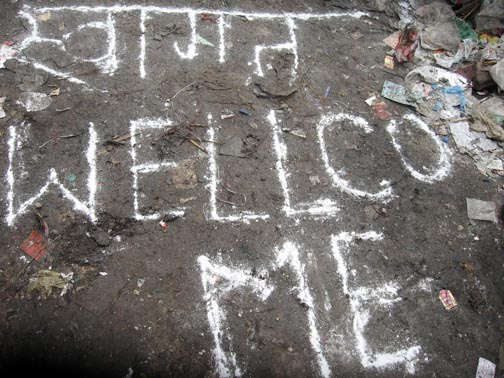
 WELCOME
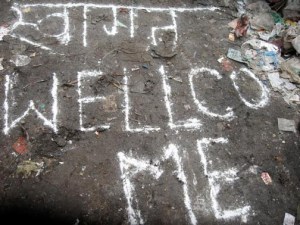
 Shashi Dhushan Pandit, a local activist, escorted us to Pua, an hour’s bus ride from Delhi. At the site, someone had written in chalk, in English as well as Hindi, “WELLCOME.” Several tarps had been carefully laid out in a clearing, upon which a ring of matching chairs awaited our arrival.

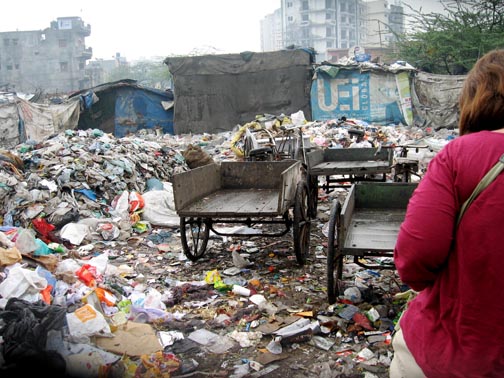
Some of the trash is loaded into a burlap bag on a bicycle cart, hauled to the basti and dumped out for the people to pick through and sort. It’s not always food they’re after, though a piece of fruit might be a bonus. They’re looking for recyclables like plastic, cardboard, clothing, fabric and metal. There is an order here—plastics, cardboard, metal in separate piles. They are not beggars or thieves—they are simply trying to eke out a living on the margins of society.

Basti and Cart
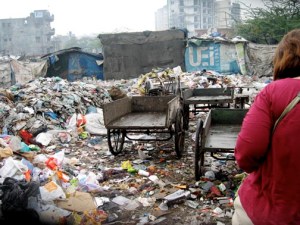
 

 Not only do people pick up trash, they also live in the dumps out on the fringes of Delhi. Stray dogs, cows, and countless flies live there as well. There were so many flies that after some time waving them away, I kind of got used to them. At any rate, I was absorbed in listening to our host.

Shashi spoke to us with passion. When he was growing up he saw that loans of 100 rupees would be charged 10 rupees per day in interest. Temples would acquire land needed by peasants. He became a well-educated activist at a very basic, grassroots level.

We didn’t need to understand Hindi to be able to get the gist of what he said: privatization is taking away their livelihood. Big recycling companies are getting the contracts. Shashi is adamant that they will not give up until their needs are addressed. Like with Austin Interfaith and other community organizing groups in the U.S., they learn how to stand up for their rights as human beings—how to use democracy effectively. They learn about the nature and advantages of unions. One difficulty in forming a union is that the workers have to name their employer. Yet who employs them? Everyone and no one!

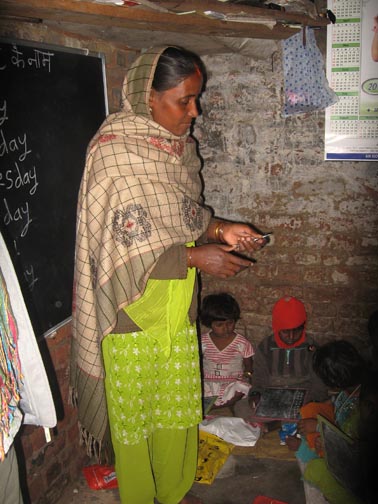
Manoj is one of the waste pickers and an activist. His wife Vivha decided to start a school with no training other than a high school education. She teaches and Manoj assists when he has time. Classes are normally held outside for about 70 children, but it had rained the night before and the ground was muddy. Instead of an open-air school, they used a small one-room building and only about 30 kids could fit inside the classroom.

Door to Classroom
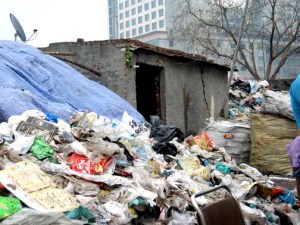
Notice in the background that a new 5-star hotel is going up next to this waste operation. The people we met are already looking for another place to live and work. Slums don’t mingle well with tourist and business travel.

 Vivha

 With very few teaching materials, Vivha teaches reading, writing, and numbers in Hindi and English (at least), about days, weeks, seasons—all the basics.

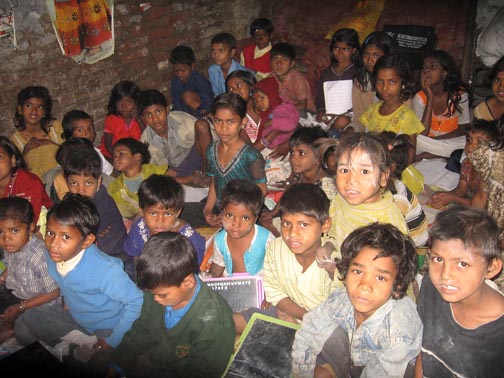
 Children in Classroom
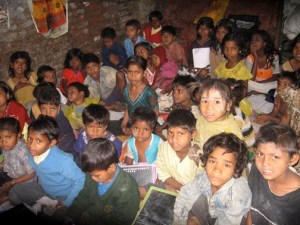
There was a wide age range, from toddlers to about 12 years old. Vivha called on students who stood to recite their lessons. She would love to offer a midday meal to the children not just for the nutrition, but also as an incentive for the children to come and for the parents to send them. Basic immunizations and check-ups are a distant dream.

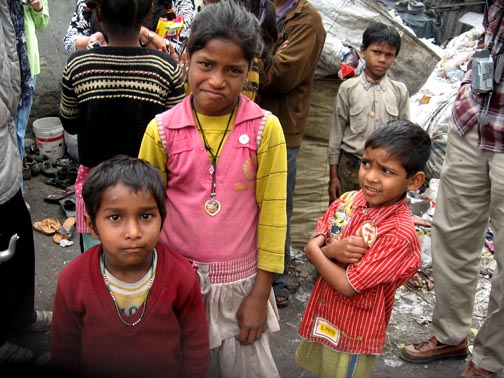
 Children


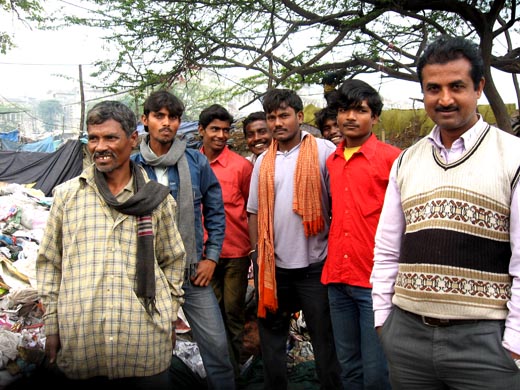
Young Men

We had been greeted by a half dozen young men who protected us from any harassment or problem. Since it rained the night before our visit, the ground was muddy and slippery. Some of the guys offered a hand to help us through the mud because it had rained the night before.

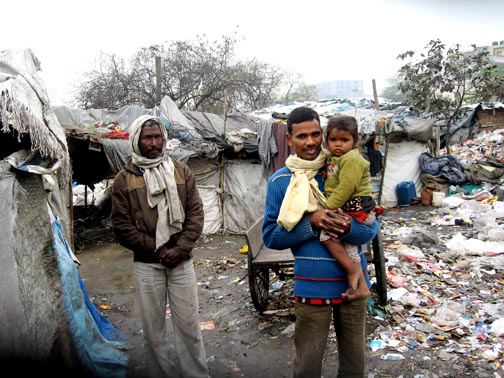
Father and Daughter with Friend
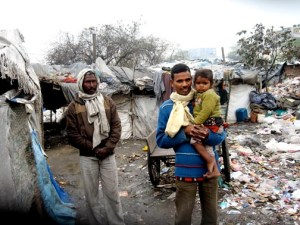
I was struck by the generous spirit of its residents. The kids were neat and clean, they offered us tea; they removed their shoes before going into their huts. The problems of hunger and malnutrition may be worse in India than here, from the sheer numbers of people and the policies against agribusiness with its pros and cons. Not many outsiders take an interest in this work so it was an uncommon opportunity for them to tell us their story.

The Indian government has special economic zones that are referred to by the workers as “exploitation zones.” These are areas in which the state acquires land cheaply (often from peasant farmers) and resells it cheaply to industry. The construction of a nearby temple that was paid for with mostly non-Indian money displaced 20 thousand people.

ID cards in red and green are prepared for the workers. Red represents labor and green represents the environment. A familiar recycling symbol appears on the back. ID cards are a step in establishing documentation as Indian citizens who might not have a birth certificate or a permanent address. After all, if you’re not born in a hospital, you won’t necessarily have a birth certificate. A significant number of the waste pickers are from poor areas of Bihar and West Bengal.

Seeing Us Off
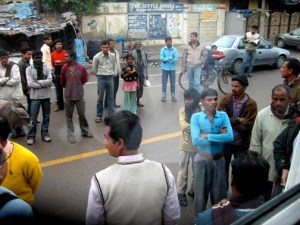
Recycling tons of waste saves the Indian government millions of rupees annually, but the waste pickers get pushed further outside the city. Some of us wondered about the birth rate, but we were reminded to consider the death rate as well—infant mortality is high, and life expectancy is low. With no health care or adequate nutrition mere survival is difficult at best.

Place to Debrief

It was a privilege to visit and witness the very private struggles and living conditions of some hard-working people. We’re still thinking about our part in this system of exploitation and marginalization. We donated some cash that will be used to repair the roof of the classroom , provide immunizations, and assist with slates, chalk, and other educational materials for the children. It may be only a Band-Aid in a system of checks and imbalances but it will make a difference for these children.

The activism described here has a UU connection. The Holdeen India Fund was established by a real estate mogul who left millions of dollars in trust funds to the UUA. He was not a Unitarian Universalist and he had never been to India, but he wanted a tax shelter. Twenty five million dollars was put into an endowment, the interest of which is dedicated to grassroots activism like this. Holdeen leaders look for people like Shashi and work out a plan that might include funding, training, and finding partners to achieve a set of goals.

Although the caste system was taken out of the Indian Constitution and is no longer official policy, the people we met briefly that day are still treated as outcasts. They often come to the city from poor, small villages and encounter culture shock. People at home are more likely to look after each other, while the city is so anonymous. No one knows or cares about each other the way they do in villages. They don’t have time for each other, any more than we do in the U.S.

The waste pickers, though, have strength in numbers and have actually fought successfully against for-profit corporations. They are working for survival, not so much for profit. Sometimes authorities side with the people, the ones who clean up after everyone else, the ones who clean up after us.

I was both physically and spiritually fed by my journey to India. I found that I need is to tend to my spirit daily—as much time as I spend nourishing my body! Perhaps you do, too. We have various ways to fill our spirits—time alone or time volunteering; time with nature or in prayer.

Sam Keen, who wrote Hymns to an Unknown God, believes that, “The spiritual craving of our time is triggered by the perennial human need to connect with something that transcends the fragile self, to surrender to something larger and more lasting than our brief moment in history (p. xviii).”

It seems that physical hunger is closely linked to spiritual hunger. To serve meals at the Austin Resource Center for the Homeless or to collect food for Hill Country Community Ministries is a small step toward feeding both hungers. Fasting for a day or longer is another way to bridge that gap slightly.

Feeding my body happens almost without thinking about it. Feeding my spirit daily is also vitally important. I wouldn’t do without it. There are probably as many ways to fill our spiritual hunger as there are people in the room.

Running on empty won’t get you very far in life. Feed your spirit so that you have something to give to a hungry world.

Amen, Shanti, and Namasté

Travel through space!

Standard

This Time Lapse Video of the Very Large Telescope At Work is the Coolest Thing You’ll See Today | Popular Science.