Author Archives: Kathleen

Unknown's avatar

About Kathleen

Spiritual Companion since 2016: A spiritual companion simply converses with one person or small group at a time to explore their connections with the universe or higher power of their understanding. Support, companionship, and mutual growth are keys to successful spiritual direction, along with a safe space for exploration. For 25 years I served several congregations as Pastor or as Consultant to pastors and/or congregations.

Kapaleeshwara Temple, Chennai

Standard

This slideshow requires JavaScript.

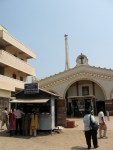
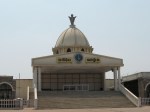
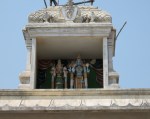
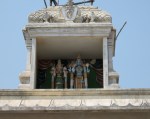
As non-Hindus we were not allowed inside this Shiva Temple, but we could take pictures of the colorful and detailed ornamentation dating back to 1250. There were side entrances, courtyards, and a tank built around the central shrine, typical of ancient Dravidian architecture.

Though there was a dry spell of a number of years, there have been Theppam Festivals during which lighted lamps are set afloat on the water. Here’s a link to a set of photos from that festival, held in January 2007:

Kalakshetra

Standard

Kalakshetra literally means a holy place of arts: Kala, arts and Kshetra, Field or Holy Place. The name well describes the intention of classical dancer Rakmini Devi Arundale. This beautiful and accomplished visionary established the Kalakshetra Foundation in the early 20th century as an academy of arts. Located in Chennai, a huge and noisy city, Kalakshetra is a beautiful, serene, quiet, and spiritual place.

Young women and men from all over the world come here to study classical Indian dance, music (vocal and instrumental), painting, sculpture, block printing, and other fine arts and crafts. After school classes are offered to children as young as 7, three days a week. Many students live on site in hostels during their years of study. Many of the teachers are former students who want to pass their experience on to a new generation.

We were not allowed to take photographs, but you can take a look here. We were allowed to walk around the grounds and watch dancers or musicians hone their craft. Bamboo shades were rolled up so doors and windows were simply large openings all around each classroom. We were captivated by the students’ precision, energy, and concentration. Every gesture, every facial expression, and every musical pattern help tell the story.

One of my favorite spots kept me rooted where I could hear three music classes simultaneously. Birds joined the chorus and leaves drifted down in a gentle breeze not far from the sea.

Later, I read from Some Selected Speeches and Writings of Rukmini Devi Arundale and recorded some interesting quotes from volume 1:

There is no such thing as “seeing” art. Art is a creative force of the response from within . . . (p. 113)

What does drama do to a person? It takes the very essence of life and puts it before the audience and so enables one to understand life far better. In drama you not only see something, apart from yourself, but you actually see yourself on stage (p. 23).

Rukmini Devi writes about four specific techniques of dance: posture of the body and gesture; spoken word; costume; and the expression of emotion in the body, e.g. change of colour, broken speech, horripulation [isn’t that a delicious word?], and shedding of tears. (from the introduction)

My favorite quote, p. 183:

To compose Kumara Sambhawa took 6 years of meditation and 11 days of composition.

Meditate on that! And tell me, how do you express your creativity?

Images of Sendai, Japan, and environs

Standard

And speaking of international borders, my heart goes out to Japan and all who live there. My son in Tokyo was unharmed, though he couldn’t get home until the trains resumed service.

Leah Korn reposted this: Japan Earthquake: before and after

Aerial photos taken over Japan have revealed the scale of devastation across dozens of suburbs and tens of thousands of homes and businesses. Hover over each satellite photo to view the devastation caused by the earthquake and tsunami.

reposting but not reposing . . .

Standard

The post from UUA President Peter Morales pretty much describes my trip from Guwahati to Shillong, Meghalaya. I traveled that road, met the people, and heard his sermon about crossing borders. Borders need crossing–international, spiritual, religious, cultural, neighborly–go for a win-win.

Click here!

Hindus, Catholics, and Unitarians

Standard

All these faith traditions and many more are readily available in Chennai, a port city on the east coast of India, on the Bay of Bengal.

First stop, the Ashta Lakshmi Temple, overlooking the beach where we could see horses available for rides and people dotting the sand as vendors or beach-goers.

Lakshmi is the Hindu goddess of wealth, both material and spiritual. How fitting to begin here, to start a journey of such spiritual bounty. We had no idea at the time of the depths of this journey, only that it was called Sacred Places and we expected to visit many.

Lakshmi is shown as a beautiful woman with four hands who is seated or standing on a full-bloom lotus blossom and holding a lotus bud. Her four hands represent the four aims of human life: dharma (righteousness), kama (desires), artha (wealth), and moksha (liberation from the cycle of birth and death. She is a mother goddess who is addressed as Mata (mother) instead of simply devi (goddess).

A full description of the temple can be found here: http://saigan.com/heritage/temple/8lakshmi.html including professional photographs. I have uploaded some of my pix, but we were not allowed to photograph inside active temples. Ashtalakshmi is a very colorful temple, unlike some that we will see later on our journey.

As we ascended levels of the temple we encountered various deities. Lakshmi, of course was on the top, fourth level, facing east. Keep in mind that the pantheon of gods and goddesses in Hindu mythology are all manifestations of the Supreme God, Brahman. Devotion to one deity or another is acknowledgment of the desired aspect in one’s life.

Next stop was St. Mary’s Catholic Church. Though Christianity is a minority religion in India, it boasts 2.4 per cent of a huge population. St. Mary’s is not fancy by any means but its focus on Mary is so refreshingly different from the symbols of crucifixion in most Catholic churches. Mother and Child overlook the altar and evoke the love and peace felt by countless mothers with their infants.

Lunch was enjoyed at a fancy Sheraton buffet. We were able to eat more quickly and with a wide array of options than ordering from a menu would offer. After all, some of us needed to ease our way into Indian cuisine. (Not I! Throughout the trip I feasted on marvelous dishes that varied by region and delighted my palate.)

After lunch we went shopping at Spencer Mall, where many of us first visited an ATM. The two shops Abhi recommended included fabrics, shawls, and scarves in one; and a large variety of good quality Indian merchandise. I was not ready on day 1 to purchase anything, but I thoroughly enjoyed looking at all the beautiful items.

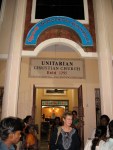
In the evening we visited Madras Unitarian Christian Church. It is located in a working class neighborhood, and that makes it easier to invite people of multiple social classes to feel comfortable. It was a Thursday evening, not easy for people to travel on a school/work night, but the place was packed.

The minister is Harrison Kingsley, who was a gracious host. We were greeted by members who presented each of us with a flower. It was artificial, to be sure, but unlike fresh flowers I still have something to show for my visit!

We were ushered to the front rows of the church as honored guests. A program began with song. While Madras members sang in Tamil, we guests were directed to the English section in the back of the hymnal. Jointly and lustily we sang, “What a Friend We Have in Jesus.” They had wanted us to feel comfortable with a familiar hymn.

The evening’s entertainment included songs and dances by children and youth, repeated from a recent special event. We saw a slide show of the history of this church. As the program came to a close, the three ministers (Abhi Janamanchi, Justin Osterman, and I) and one director of religious education (Jennifer Halperin) were presented with colorful shawls. The closing hymn, also familiar and sung in either Tamil or English, was “Abide with Me.”

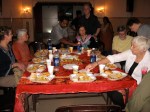
Social hour followed on the front patio. We were invited up to the Fellowship Hall for tea–plus a thoughtful selection of sandwiches, homemade potato chips, and a mildly sweet pastry. Most of the members continued to socialize downstairs! We enjoyed our repast and easily decided we had no need for a restaurant dinner.

Thus ended our first day in Chennai. We hit the ground running–no time for jet lag!–and fell into bed at the lovely Hotel Pride.

On the move again

Standard

Our group was in the news back in Rajahmundry. There are many inaccuracies due to circumstances, assumptions, and language barriers, but how nice that we were noticed by the media! Also a story on local TV news that day.

Flights are heading back to the U.S. at various times today and tomorrow. Will do some backtracking and post other stories and photos from earlier in the trip as I recover from jet lag.

Meanwhile, one more shopping opportunity!

Thanks for reading along!

Kathleen

Ever wonder what happens to your trash?

Standard

This slideshow requires JavaScript.

Trash!

You can throw it away and forget about it. Maybe you’ll recycle it. You’ll see someone throw a plastic cup out the car window and wonder about her/his character. You notice trash in a park and sometimes you pick it up for disposal. You see someone going through a dumpster and recoil just a tiny bit.

Streets are pretty clean in Delhi as big cities go, but not all the trash is carried away in large trucks. However, private contractors are taking away a big source of revenue from the poorest of the poor: the waste pickers. You might have seen them going through dumpsters or picking up trash alongside roads and buildings. It’s not food they’re after, though a piece of fruit might be a bonus. They’re looking for recyclables like plastic, cardboard, clothing, fabric and metal. They are not beggars or thieves—they are simply trying to eke out a living on the margins of society.

Not exactly number one on most tourist itineraries are the dumps out on the fringes of Delhi. Shashi Dhushan Pandit is an activist who could see the exploitation of poor people. Loans of 100 rupees would be charged 10 rupees per day in interest. Temples would acquire land needed by peasants. Shashi became a well educated activist at a very basic, grassroots level.

He escorted us to Pua, an hour’s bus ride, where dozens of people, dogs, and flies live among piles of trash. There is an order here—plastics, cardboard, metal in separate piles. Bicycle carts bring in new loads for the people to pick through and sort. Since it rained the night before our visit, the ground was muddy and slippery. Not many outsiders take an interest in this work. We were met with a half dozen men who protected us from any harassment or problem. Some of them offered a hand to help us through the mud.

At the site, someone had written in chalk, in English, “WELLCOME.” Several tarps had been carefully laid out in a clearing, upon which a ring of matching chairs awaited our arrival. Shashi spoke to us with passion. We didn’t need to understand Hindi to be able to get the gist of what he said. He and his people will not give up until their needs are addressed. He and others are already educating multiple sectors of waste pickers about services available and how to practice democracy. (Like IAF/community organizing groups in the U.S.), they learn how to stand up for their rights as human beings. Another level of education is about the nature and advantages of unions. One difficulty in forming a union is that the workers must name their employer. Yet who employs them? Everyone!

The Indian government has special economic zones (aka “exploitation zones”) in which the state acquires land cheaply (often from peasant farmers) and resell it cheaply to industry. The construction of a nearby temple with mostly non-Indian money displaced 20 thousand people. A new 5-star hotel is going up next to this waste operation so the ones we met are already looking for another place to go.

A few notes help explain the pictures: Vivha teaches and her husband Manoj assists, though he also works as a waste picker and an activist. Classes are normally held outside for about 70 children, but since it rained the previous day, they used the small classroom and fewer were in attendance. There is a wide age range, from toddlers to about 12 years old. Vivha has a high school education and very few teaching materials, but she teaches reading and writing in Hindi and English (at least), about days, weeks, seasons, numbers—all the basics. I recorded one girl’s recitation when Vivha called on her. Vivha would love to offer a midday meal to the children for the nutrition, certainly, but also as an incentive for the children to come, for the parents to send them. They also need basic immunizations and check-ups.

ID cards are prepared for the workers. The color red represents labor and green represents the environment. A familiar recycling symbol appears on the back. ID cards are a step in establishing documentation as Indian citizens who may not have a birth certificate or a permanent address.

Recycling these piles of waste save the Indian government millions of rupees annually. The waste pickers get pushed further outside the city. Some of us wondered about the birth rate, but we were reminded to consider the death rate as well. With no health care or adequate nutrition mere survival is difficult at best.

Those of us who had the privilege of visiting and witnessing the very private struggles and living conditions of some hard-working people are still trying to process what we’ve seen. We’re thinking about our part in this system of exploitation and marginalization. We collected 23,000 rupees among us to assist with slates, chalk, and other educational materials for the children.

The Holdeen India Fund was established by a real estate mogul who left millions of dollars in trust funds to the UUA. He was not a Unitarian Universalist and he had never been to India, but he wanted to shelter his estate from taxes. After he died there was a long period of negotiations with his family and finally $25 million dollars was put into an endowment, the interest of which is dedicated to grassroots activism like this. Holdeen leaders look for people like Shashi who are doing the work, sit down with them and make a plan. This could include funding, training, and/or seeking additional sponsors to achieve a set of goals.

Though the caste system is no longer official policy, the people we met briefly are among the poorest of the poor. Often they come to the city from poverty in small villages and encounter culture shock. The city is so anonymous. People don’t know or care about each other the way they do in the villages. They don’t have time for each other. (Does this sound familiar in our fast-paced society?)

The waste pickers, though, have strength in numbers and have actually fought successfully against for-profit corporations. They are working for survival, not so much for profit. Sometimes authorities side with the people, the ones who clean up after everyone else, the ones who clean up after us, after me.

Unitarian Schools

Standard

From the Khasi Hills in Northeast India—Shillong, Meghalaya

This morning, 28 Feb 2011, we set out to visit 2 of dozens of Unitarian schools in northeast India. The Education Committee of the Unitarian Union now runs 37 Lower Primary Schools, 10 Upper Primary Schools and 4 Secondary Schools

The UU Church in Clearwater, FL, is a sponsor of the Margaret Barr Memorial School. The school has about 60 students from pre-K through 7th grade in the village of Lawsohtun. Founded in 1982, the school gets some funding from the State of Meghalaya but subsists mostly on donations. A few families can afford a materials fee of 20 Rs/month, but most of the students are from peasant families and do not pay. Most of them wore uniforms, and I’m sure they are handed down and altered.

Two rows of children politely lined up on both sides the gate to greet us with shy smiles and a corsage of ribbon and beads. Chairs were waiting for us in the shade of the porch where we enjoyed a program of welcome and songs from the children.

After the program we had a tour of the school. The computer room is the size of a closet. It has one working computer and one that needs repair. There is no internet, so all they can learn are applications. For languages, they study their native tongue Khasi, the more formal Hindi, and English. One class sang the alphabet song for us in English.

The head teacher and 7 other teachers receive appallingly low salaries—about 1800 rupees/month (less than $40). Government schools pay at least 3 times that amount, namely, 6-12,000/month. Even so, one of the teachers said he bought pencils and other supplies out of his salary. Before leaving the site, we took up a collection on the spot and gave each of them a cash bonus.

Margaret Barr, for whom the school is named, was a Methodist born and raised in Yorkshire, England. She became a Unitarian in 1921 as a student in Girton College, Cambridge, after a friend invited her to a service. The sermon that day was a scholarly and appreciative explanation of Hinduism. She loved the Unitarian approach to other faiths. Barr went on to become a minister herself.

While she was serving Rotherham Unitarian Church (1927-33) she learned about the indigenous Unitarians in the Khasi Hills of India and about their founder Hajom Kissor Singh. After a visit there she wanted to return. Several years later she got a job at a girls’ school in Calcutta that paid for her move to India.

Eventually she made her way to the Khasi Hills, where illiteracy, poverty, and ill health predominated. H.K. Singh had died and the congregations were floundering. She opened a school and trained teachers in Shillong. So that students didn’t have to leave home, she opened another one in Kharang, then a Dispensary, and finally made Kharang her permanent home. She would open schools in villages then turn them over to the Government. She died in 1973.

Clearly, Margaret Barr heeded the advice given to her by Gandhi: “Keep out of jail and find some constructive work to do.”